Tuesday, November 23, 2010

Quick Sour Beers: Classic Gose

I am a huge fan of sours beers as you may tell from most of my posts. The tough part about these beers is the waiting. Which is one reason why I am making as many as I do. By about May of next year I'll have a new sour beer every month from my 1 gal experiments. In the mean while I want something with a decent turn around. And then I saw this post and that it sounded great (he also does a great job at explaining the style). I also really liked the idea that Cascade Brewing does by having a new Gose for each season. I figured I should start with the classic example (Stan Hieronymus explains "goes-a" well).
For this new beer I decided to do a 1 gallon batch so I can understand the technique before investing too much. Since this is only a gallon batch I thought it is also a great time to do some stove-top brewing. And that means brew-in-a-bag time and No Sparge.
Recipe: Classic Gose
O.G.-1.043?  F.G.-1.005   IBU-12.7
SRM-5  ABV-~2.5%?   Cal-120

Grain Bill (75% Efficiency-Missed it by a mile):
14 oz White Wheat Malt (56%)
10 oz Belgian Pilsner (40%)
1 oz Acid Malt (4%)
3 g Indian Coriander (added with 5 min in boil)
3 g Indian Sea Salt (added with 5 min in boil)

Hops:
.1 oz US Goldings, 4.9%, pellet, 60 min 12.7 IBU


Yeast:
1/2 packet of Red Star Bread Yeast
 Brew Day:
Brewed: 11/9/10
Bottled: 11/21/10

Water:
San Diego (Alvarado) Filtered Water

Mash Details:
H2O/Grain Ratio: 3.8 qt/lb
Mash Volume: 4 gal
Sacc Rest. Temp/Time: 149F @ 60min
Strike Temp: 153F
Batch Sparge Volume: No Sparge


Sour Mash Details:
O.G.: 1.030
Sour Mash Temp: 115-120F (keep warm setting on Crock-Pot)
Length: 4 days
Boil Details:
Boil Volume: 1.2 gal (used sour gal + 22 oz bottled wort)
Boil Time: 60min
Post Boil Volume: ~1 gal

Ferment Details:
O.G.: 1.030?
Ferment Temp: 70-75F
Length: 7 days in primary
F.G.: 1.005

I bottled this with 1 oz of corn sugar for the gal. shooting for just under 3 volumes. Since this was boiled and uses Sacc. yeast I am not concerned with bottle bombs. Yes, there is probably some lacto from the bread yeast but it probably won't produce CO2 and there was very little residual sugar anyways.

A few notes:
  • I think I lost way more efficiency than I expect with the brew in a bag and no sparge. So next time plan for that.
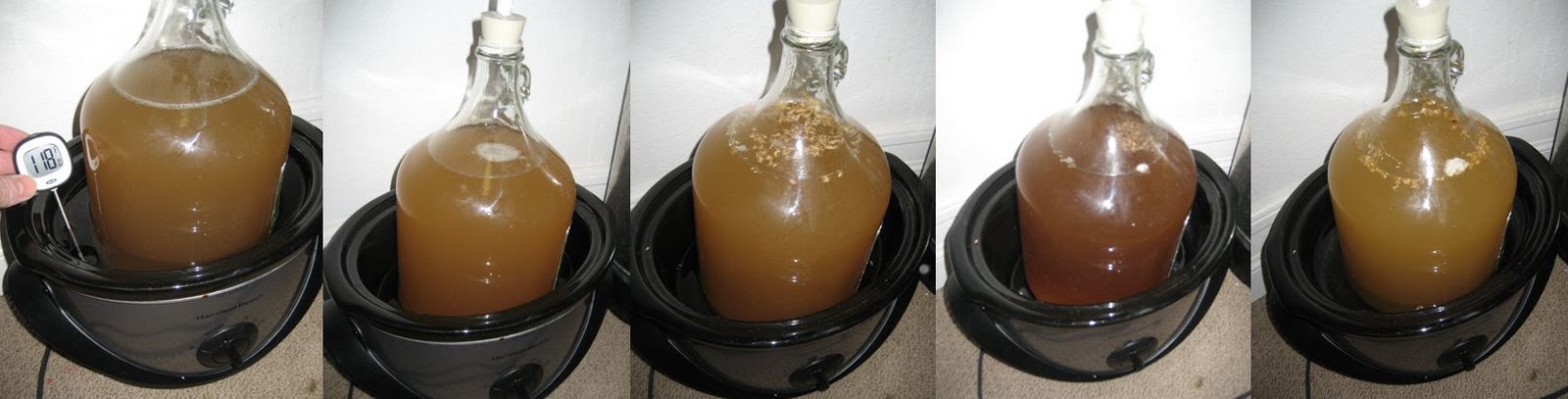
  • I tried a method that worked before that just involves running the wort from the mash tun straight into the fermenter. The max temperature the wort sees is 150 and therefore the lacto and other bugs should be ready to go. But it didn't seem to take off so I added some grain (which I will do in the future to ensure I get lacto). At no time did it form a layer on top but after 4 days the wort had a nice sourness but also a somewhat nasty rotted corn smell. Good thing this is getting boiled off.
  • The Crockpot worked great 
  • The hydro sample was nicely tart but didn't have much malt or other flavors to it. This is probably a result of the low starting gravity.


Tasting to Follow...

Saturday, November 20, 2010

Cider Series: Spiced Belgian with "House" Brett

So this beer got out of hand and not really on purpose. So as explained before I use 1 gal containers to do all my Dreg Series beers. And the cheapest way to get 1 gal glass jugs is with cider in it. At Henry's I noticed they had a new Santa Cruz Organic Cider. The jug was actually 3/4 gal and I figured that size might fit better in my brewing cabinet.

So the yeast I had at this time was WLP500 the Chimay strain (from my Trappist Series). I thought that this might be a great yeast for the clove notes you can get at the higher fermentation temperature range. I pitched about 50mL of the yeast. This beer was fermented in my brewing closet which is from 70 -75F.

This cider was fermented while I was out of town for a week. I noticed when I got back that the stopper was knocked off. At that time I didn't notice anything different with the beer. At this point I took a gravity reading and taste. Very dry down to 1.002 and just a bit of clove and fruity esters. Not as much character as I was hoping for.
I realized the holidays are coming up so lets really boost the spice. So I toasted 2 sticks cinnamon, 1 tsp all spice, 1 tsp cloves until they just start to smell. (As a sidenote this is a great way to instantly have the house smell like the holidays). A cup of cider was added and simmered for 15 minutes. This was cooled and added to the cider. And then....
Looks like we have a Brett infection. I guess it was just waiting for a bit of sugar and probably oxygen to become visible. There is hardly any sugar left in the cider so I didn't think that I would get much Brett character.
After a few weeks I decided to bottle this beer. I wasn't concerned with bottle bombs since there isn't much sugar left. I bottled using 5 oz fresh 1.050 cider. I calculated by assuming it takes me .7 oz of sugar to get 3 volumes in .75 gal of cider. Calculations:
 

.7oz/16oz = .04375 lb 

.04375 lb x (45 pts/1 lb) = 2 points

2 points x (1 gal/50pts) = .04 gal

.04 gal x (128 oz/1 gal) = 5.12 oz


I assumed that the cider will not be 100% ferementable like the sugar but it should be close because of the Brett. So this should end up very dry but I am a fan of sweetening once in the glass. (Just pour an once or two of fresh cider in your glass)

Wednesday, November 17, 2010

SDBW: Tasting with Eric Salazar of New Belgium

San Diego Beer Week was amazing. I don't know where to start so I picked my favorite event. Plus this is educational.
On Thursday Nov. 11 at Blind Lady Ale House (or BLAH) they had a special flight of New Belgium beers (mostly sours). And for a select group we were guided through the beers by Eric Salazar (think Eric's Ale) who is a big player in the New Belgium sour beers. Eric has been working at NB for around 15 years. He is heavily involved in the Lips of Faith series. He had the chance to brew Eric's ale by winning a contest where 3 beers are blended and whoever can guess the beers and proportions gets to brew their beer (The Lips of Faith series started as a way to get all employees involved with brewing and that beer was served at the brewery, now it refers to their unique beers). On to the beers.

The Flight and my notes:

Trans-Atlantic Kriek - Boon's Oude Kriek (6.5%) that is 50/50 blended with their Strong Golden Lager (they seem to use this base beer often. By my calcs it is 9.5%. I think it is used to really build body in their beers). Eric explained that Frank Boon sends them an "oil tanker" of the beer. And they were instructed to feed the Golden Lager into the Kriek (Eric and I both can't figure out the reason)

Biere de Mars - I didn't get a lot about this beer but also wasn't to impressed. It only had a mild Brett character which is Brett L (according to Eric) and its added at bottling. After the fact I'm not sure how this works. How do they know how if they will have bottle bombs? And an issue we talked about later is that they don't want bugs to contaminat the bottling line.

Sahti - Interesting beer that I will have to try at home. They used juniper boughs in the mash tun which seems like a lot of fun. And it had a nice "gin" finish that I actually liked.

Belgo IPA - Not much to talk about here. They used 1 of their 2 house Belgian strands (the more clove forward strain) but that was hard to find under all the hops.

Eric's Ale - This beer starts as a Strong Golden Ale and then peach juice is added. In order to make sure that this beer is not too sweet a lager yeast is pitched. Once this ferments out then it is blended with Felix (more info below). My follow-up questions will include what type of peach and how much.

La Folie - The American Rodenbach. This beer is just a blend of Oscar (see below).

I tried to figure out how they approach sour brewing at NB. So from what I understand from my conversation with Eric. They started with the traditional bugs (lacto, pedio, brett) and pitched them into a bunch(lots) of barrels. And over the course of several years they got rid of the bad barrels and repitched more of the bugs from the good barrels (not sure how they control their ratios, like lacto getting out of control, more Qs). Eventually they moved up to using French Oak foudres. They now have 20 with 10 filled with Felix and 10 with Oscar. Oscar is their dark sour base (La Folie) and Felix is their pale base (Eric's Ale, Tart Lechee). Each of these foudres taste a bit different based on their location in the brewery. (This made me want to try the same wort and bugs but in different locations in my house). Supposedly foudre #3 is tasting really good right now. And once and a while you will here about a LOVE barrel. This is a single barrel or foudre that tastes great on its own. It can be Oscar or Felix. Some of the beers after they are blended are left to age in the barrel.

Mike, the Mad Fermentalist, wanted me to ask about how they package the beer now compared to pre Lips of Faith. So I asked Eric and he explained the main change has been do to the volume change. Since moving to a Lips of Faith series they now produce 300 hectoliters instead of 30 hectoliters. And this means that the beer needs to be bottled on their main bottling line. And that means it must be pasturized so as to not contaminate the rest of their beers. Before it was all hand corked! And this allowed the beer to be in a different part of the brewery and these bottles could take the added pressure over time. Good News. Eric said they should have a corking line soon.
Eric Salazar with the New Brew Thursday Cast in front of foudres 
Eric also mentioned to look out for their Collaboration with Allagash on a beer called Vrienden. For a good article and video. check it.

Eric was a very nice, down to earth guy that amused my questions. He actually turned a few questions back on me. And was very interested in what people are doing with homebrewing sours. I plan to follow up by sending him a few beers and a few questions I didn't think about at the time.
And Thanks Dan and Meagan for drinking with me and putting up with my nerding out.
Related Posts Plugin for WordPress, Blogger...