Friday, August 30, 2013

Belgian Grand / Petite Cru Based on Candi Sugar


I have been planning to brew a beer where the flavor is almost solely based on candi sugar. In the book, Brew like a Monk, Stan explains that this is how many Belgian brewers create their darker beers. This intrigued me because I really like the taste of candi sugar. The only part missing was that I needed to figure out how to make candi sugar. This is a highly debated subject (almost to the level of plastic vs. glass fermenters) on the ingredients and techniques used to create these syrups.


I have done a huge amount of research over the last couple years and have decided Ryan at Ryan Brews knows what he is talking about (he uses science). I read his article and then re-read it (and all the comments). His flavor tasting chart is pretty awesome and makes it convenient to have a point to aim for. Having made candi sugar a couple times in the past, I know it makes a mess. Here is some advice (if you have a wife like mine), go buy your own pot (I got a non-stick one from a thrift store for $2) or use your brew kettle. Also make sure you are outside or at least in a place you can make a mess. I actually went far enough to buy a cheap ($16-shipped) electric burner  which is also get for boiling starters since my wife is not a fan of the house smelling like wort. Sugar is actually pretty easy to clean with hot water, but it gets everywhere.
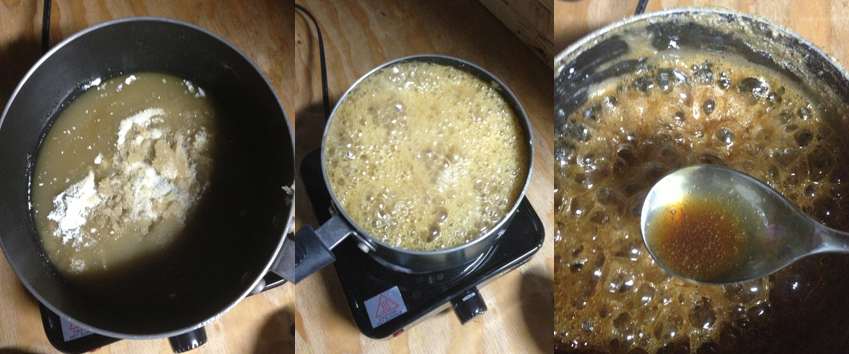
The flavors in Ryan's "Lime+Nutrient" batch sounded like what I wanted. As he discusses in the article, this is not a recipe but a guideline. For the first batch, I followed it as a recipe so I had somewhere to start. Well, the first thing I noticed is that the times he lists for flavor development weren't even close for me. After 3 hours of boiling, I got something that was pretty close to his "25 min" syrup. I think my issues had to do with the power of my burner and me adding too much water and not allowing the syrup to get to high enough temperature to create Maillard reactions. My second batch I decided to go for it and do a larger quantity in my old brew kettle on the propane burner. This seemed to develop color and flavors faster, but still much slower than expected. And I did get some slight smoking and burning. The resulting syrup had some burnt bitter astringent flavors. According to Ryan this is probably because I let the pH drop too low without adding more lime. I'm going to keep trying and if anyone has suggestions (or can post a video, I'm a visual learner) please send it my way.

My candi sugar wasn't bad, but just not exactly what I wanted. Therefore off to my local ethnic food store to pick up some date molasses and carob molasses. The date molasses is gold and when mixed in 50/50 with my candi syrup it tasted great. I added a little carob molasses to give some chocolate notes (maybe).

As explained above, the grain bill was kept simple to provide enough bready flavors, but stay out of the way of the candi sugar. Hops were just to added for bitterness to balance the sweetness. My mash temp was in the mid range because I like my Belgian beers dry, but I wasn't totally sure how fermentable my candi sugar would be.

The next strange part of this brew session is about 2 days before I was going to brew I saw this post from Modern Times. I decided that I could dilute down some of the wort (4 gals wort, 1 gal water) and also not add first runnings to be able to get a session strength version that could be ready in 8 days. For lack of a better name, a Petite Cru or Belgian Dark Session Ale. This also meant that I would now have 1 gal of wort left over. I had a starter of Maredsous dregs going, so that decision was easy.

Grand Cru / petite cru

IBU: GC ~25, PC ~20       SRM: TBD      Batch Size: 10 gal  (5 gal - GC,  5 gal- PC 1 gal - Mared) 
O.G.: GC ~1.070, PC ~1.045, Mared - 1.055              FG: GC- TBD, PC - 1.005, Mared - 1.008 

Fermentables 
Name                            Amount          Color
Pilsner                          15.000 lb         2 L
Munich Malt                    3.000 lb        20 L
Wheat Malt                     3.000 lb          5 L

Sugar:
Grand Cru (5 gals) - 12 oz Date Molasses, 16 oz Homemade Candi Sugar, 2 oz Carob Molasses, All 1st Runnings
Petite Cru (5 gals) - 5 oz Date Molasses, 10 oz Homemade Candi Sugar, 1 oz Carob Molasses
Maredsous (1 gal) - 1.5 oz Date Molasses, 3 oz Homemade Candi Sugar, 1 oz Carob Molasses

Hops 
Name                 Alpha      Amount      Use      Time         IBU
Super Styrian    9.5%        1.25 oz       Boil     60 min      25.4

Yeast
WLP 530  - Slurry from Belgian Blonde in 1 liter starter - split in Petite and Grand Cru
Maredsous dregs - built up 50 mls (3 days) then 100 mls (2 days)

Brewing Process 
Mash at 152 grain for 30 min
Took a gallon of the first runnings and boiled until thick
Boil 60 min

Fermentation
Petite Cru was fermented in glass carboys at 63 degrees for 6 days then raised to 68. Kegged Day 8.
Grand Cru was fermented in glass carboys at ~70 degrees and free rise ~75
Maredsous was fermented in glass jug at ~70 degrees and free rise ~75

Big shocker here, but I did not win the Modern Times competition. That beer just did not turn out like I planned. It was done fermenting, but the flavor profile was just weird. I'm thinking that it may take some time for the flavors to come together. Also to note I did not get nearly as much color contribution as I thought I would. (estimating SRM of homemade candi sugar is tough) My plan for next year is to meet in the middle with a balance of specialty grains and candi sugar.

Update:
Petite Cru - still has a strange flavor profile and I felt like spicing it. I don't do this often, but I was in the mood. I used 3 twigs of cinnamon, 8 oz golden raisins, 1 bourbon vanilla bean, zest from 2 oranges. So far the flavor is pretty nice, but the raisins added too much sugar so I took the keg out of the keezer and I'm going to let it ferment out a bit. Also the orange is a bit over the top - maybe just zest from 1 would have been better. I'll let this mellow for a month and have it back on for the holidays.

Grand Cru - this got an ounce of Hungarian oak cubes and is sitting in a keg.

Maredsous - bottled

Friday, July 26, 2013

The Great Brett Experiment w Eureka Brewing

Sam at Eureka Brewing has an amazing yeast collection and is sharing some of it with the WORLD! If you didn't already know Sam is a biologist from Switzerland that does some isolating of unique strains. Sam has access to a lot of great beers over in Europe and has used his talent to isolate yeast (Saccharomyces and Brettanomyces) and bacteria. Quickly go read the background and scope of this experiment at Eureka Brewing. I recently came across his list of isolated Brett Strains and thought it would be a lot of fun to experiment with them. Neither of us have any idea how these will taste or perform.
Recipe:
I created a simple recipe that I thought would be interesting enough for us to enjoy the taste of the beer, but not too complex to distract us from the yeast derived flavors. For the recipe, I added some wheat to help with mouthfeel (protein) and long term food source (long chain carbohydrates). Then a small percentage of acid malt was added to give the Brett strains some lactic acid to convert and to also lower the pH for the mash and Brett fermentation.

Logistics:
Sam will be sending the yeast in 1.5 mL vials (mostly to help with international shipping costs). These will need to be built up. I've read that you should build up about 10x each step. I'm planning to brew wit hall 20 strains at once. My goal is to have 20 - .5 gal trials going all at once - here is how I plan to do that.

First Starter Step -  15 ml (~.5 oz)
15 ml Sterile Centrifuge tubes (~$15 and great for saving dregs)

Second Starter Step - 150 ml (~5 oz). Here are my ideas:
250 ml flask w stopper/airlock or foil (laboratory way), but expensive
12 oz beer bottles w stopper or foil (pretty cheap, but the stoppers/airlocks would be pricey)
12 oz water bottles w 1/8" blow-off tubing sealed into cap or foil (cheap)

Main Batch - 1.5 l (~50 oz) - maybe a bit more to get 4 beers worth
64 oz growlers w stopper/airlocks (homebrewer friends have extras - especially with CA laws)
2 liter water bottles w 1/8" blow-off tubing sealed into cap

Evaluation:
We wanted to make sure we standardized the evaluation of the strains. We thought it was best to taste at Month 1 (uncarbonated at bottling), Month 2, Month 6, 1 Year.  I have created a Brettanomyces Evaluation Scoresheet (based on the AHA Scoresheet). We will compile the tasting notes, scores and sour/funk ratings.

Brettanomyces Evaluation ScoreSheet (pdf)

This is a Rough Draft - see please add comments

I am aware that this experiment is not possible for everyone, but I think it is important that we evaluate the flavors as best as possible. For my experiment, I will offer 3 spots for the tasting panel at my house. (leave a comment if interested)

Friday, June 28, 2013

Mosaic Pale Ale Split: Conan Vs. Drie

I had another quick brew session (~3 hrs for all - grain) as time is quite limited with house projects and the baby. I wanted to make sure I had some hoppy beer on tap for my birthday BBQ. I also have been meaning to brew another hoppy beer with Brett Drie, since I loved my first Extra Special Bretter (ESBrett). Speaking of yeast, I recently was sent some Conan (Alchemist's Heady Topper) yeast from Derek at Bear Flavored Ales and some Brett Custerianus from Ryan at Yeast of Burden. It only made sense to do a large batch and split it to test the yeast.


For the hops, I happened to purchase some Mosaic hops earlier in the year when we were planning our 2nd batch for the barrel (still not brewed). I've read a good amount about this hop and many brewers are using it as a single hop. I thought I'd give it a go since I don't know anything about hop blending anyways.


As for the recipe, I wanted something fairly simple since I want the yeast flavor differences to be obvious and to taste the hops. The recipe is about as basic as possible. I did make one tweak in which I added some rye malt to help build some body that the Brett Only batches would need.


Mosaic Pale Ale

IBU: ~30       SRM: ~7      Batch Size: 10 gal  (5 gal - Drie/Conan, 1 gal Custers) 
O.G.: 1.051              FG: 1.017 (Conan),1.009 (Drie), 1.006 (Custersianus)

Fermentables 
Name                            Amount          Color
American 2-row            14.000 lb         2 L
Munich Malt                  2.500 lb        10 L
Crystal 40L                     1.000 lb         40 L
Rye Malt                         1.000 lb          5 L


Hops 
Name         Alpha      Amount      Use      Time         IBU
Warrior     15.5%        1.25 oz       Boil     30 min      24.8
Mosaic      12.5%        1.00 oz       Boil     10 min       6.2
Mosaic      12.5%        1.00 oz       WP       0 min         0

Dryhop:
Conan - 1 oz  Mosaic for 7 days at 70F, 1 oz Mosaic in keg
Drie - 1 oz  Nelson for 7 days at 70F, 1 oz Mosaic in keg
Custersianus - .25 oz Citra at 70F

Yeast
Conan
Drie - 100 ml slurry
Custersianus - 30 ml slurry

Brewing Process 
Mash at 154 grain for 30 min
Boil 30 min (quick batch and no need for long boil)

Fermentation
Conan was fermented in glass carboys at 63 degrees for 10 days then raised to 68.
Drie was fermented in glass carboys at ~70 degrees
Custersianus was fermented in glass jug at ~70 degrees


Tasting Notes at Kegging:
Conan - Fantastic - huge fruity esters from both hops and yeast, nice firm bitterness and tastes pretty dry with the high F.G. (1.017)
Drie - Aroma is great and full of fruit, taste is a bit strange with some slight tartness that doesn't work with the bitterness, then a phenol astringency in the finish - Not good and I'm pretty sure my pitch of Brett Drie is now going to be retired.
Custersianus - Very fruit forward with that ripe funky nice to let you know its wild. Nicely dry and a bit thin, no astringency or tartness

Official Tasting Notes coming soon (hint: Conan version is almost gone- yum)

Related Posts Plugin for WordPress, Blogger...