Tuesday, May 21, 2013

Old Ale Charity Brew Session

A couple weeks back, a friend of mine inquired about supplying some homebrew for their non-profit's (Hope Through Health) charity event. The event is called "Cask for a Cause"(details) and will be held at Local Habit at 5:30 on Thursday, May 23rd.


I asked her what type of beer she would like me to brew for the event and the first response was an IPA. I immediately responded that its not really my style plus, there would be about 5 world class examples on tap at the same time. I knew that the deadline was approaching, so I wasn't sure if I'd be able to brew a beer in time so I offered the keg of my 2011 Oud Bruin. I actually hadn't tasted it in a while (since before I moved), so I took a sample of it that night. The beer had a great tart cherry nose and quite a bit of sourness (even a bit acetic since it was sloshed around during moving). It was good, but I knew it would need to be blended. I initially thought it would be too sour for the general public and secondly it was kinda dry and thin for my liking. That lead me to want to brew a blending beer.


I thought the Old Ale style would be a great beer to blend as they have some of the dark fruit flavors. Plus I like to make them on the sweeter side, which would give a nice sweet-sour balance for the masses. In addition, I can make a lower gravity Old Ale in about 2 weeks and it can still have some nice complexity to add to the blend.


2013 Old Ale (for Blending or Sour Base Beer) 

Batch Size: 9.000 gal       O.G.: 1.058 , 1.072               FG: 1.020
IBU: ~25, ~30                  SRM: ~18                         ABV: 5%, 6.7%


Fermentables 
Name                            Amount Color
Maris Otter                 19.000 lb       3 L
Rolled Oats                   1.000 lb        1 L
Crystal Extra Dark     10.000 oz     155 L
Special B                     10.000 oz     160 L
Chocolate Rye               6.000 oz       3 L
Total grain: 21.625 lb


Hops 
Name                  Alpha      Amount      Use      Time                  IBU
Super Styrian     9.5%        1.75 oz       Boil     90.000 min      29.5


Yeast
Safale S-04 (1 packet each carboy- rehydrated in warm water - Per BKYeast)

Brewing Process 
Mash at 154 grain at 1.25 ratio
Slow sparge for maximum caramelization
Boil 90 minutes for more caramelization
Run off 4 gals to carboy and top up with 1 gal boiled water - 1.058
Run off 5 gal to carboy - 1.072

Fermentation
Both batches were fermented in glass carboys at 65 degrees - raised to 68 on Day 7.

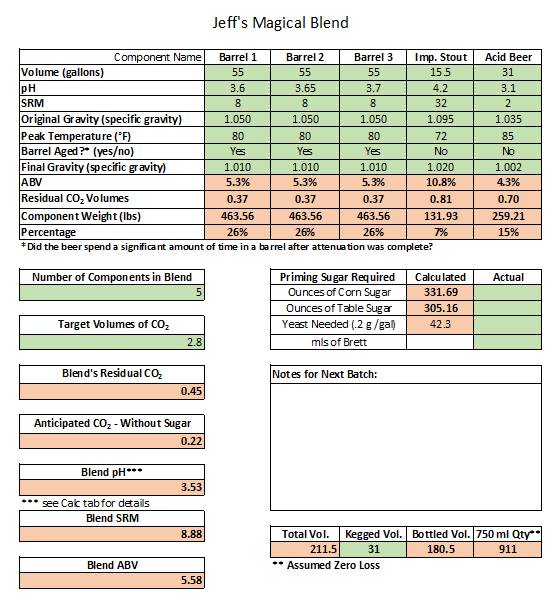
To figure out the final blend I took the beers (Old Ale, Oud Bruin and my Imperial Stout). I helped guide the tasting and it was unanimous that everyone like the sour beer at its current state. Then I suggested a splash of the Imperial Stout because it worked so well for my Oud Bruin in the 1st Rd of NHC. All agreed that the Imperial Stout really improved the beer. So much for the Old Ale I brewed, but it makes a great base beer for a sour beer and I have some East Coast Yeast Bug Country on its way. And I'm thinking the other half will get some oak and black treacle (and stay clean).
If anyone has this Thursday free, please come try some free sour beer and support a good cause. I'll be there all night, but not sure how long the beer will last.

Monday, May 13, 2013

Homebrew Tasting: NHC 1st Rd Results

I decided (and actually was able) to enter 3 beers into this year's NHC Competition. It is always tough for me to enter beers since I don't often brew to style guidelines. I do however like the idea of anonymous feedback and validation if you win is pretty nice also. The price has gone up considerably in past years, so I try to be more selective about entering beers that don't have any obvious flaws and I'm on a quest to perfect. The other benefit is that I like readers to be able to see tasting notes from beers discussed on this blog (so you don't have to trust my opinion).


Spolier Alert: 1 of my 3 entries won 1st and will advance to Rd 2.

Category 17B : Oud Bruin - Score: 40 - Place: 1st
This is a style I have tried to brew for several years and with mild success as a stand alone batch. In my opinion this style is extremely difficult (or lucky) to brew an outstanding example without blending. Mine have always gotten too sour, dry and funky. Here are recipes for those attempts - 2010 , 2011. I decided to do some blending with beers I have on hand and enjoy separately  The Oud Bruin final blend consisted of:
75% - 2010 Flanders Red - first Roeselare pitch - so it was barely tart, had a great cherry nose, but lacked any malt complexity
15% Imperial Oatmeal Stout - at ~14% , this is a super rich, dark fruit, malt bomb - a definite sipper and thick
10% Belgian Dark Strong w Maredsous dregs - Rich dark candi sugar flavors, a bit sweet for the style and balanced Belgian esters/phenols

They liked the complexity, which I really think is only possible with blending and that I kept the tartness on the subtle side. I think sourness is where most people go wrong with Oud Bruins. I think there should just be enough tartness to make the fruity esters pop.

Score Sheets:


Category 17C: Flanders Red - Score 33.5
I have been brewing this style the longest and I think I'm closing in on a recipe and process that will work without blending. My previous batches have been good on their own, but are really nice when I mix in some beer with a rich dark fruit malt character.

85% 2011 Flanders Red - Nice beer on its own, good level of sourness, nice tart cherry nose just lacks malt complexity
10% Imperial Oatmeal Stout  - my go to malt complexity blending beer
5% 2010 Flanders Red Kriek - just my 2010 Flanders Red with a lb of tart cherries aged in a gallon container

This one was a bit of a head scratcher as far as the judging remarks. They mention everything that the style should have and that is a great example of the style but then score it relatively low. I think it comes down to the individual judging tastes and that the beer didn't have enough WOW factor. I actually thought I was going to get dinged for too much acetic acid (the kriek is quite acetic for me), but that might go to show I have a lower threshold than most. I think the judge comment about metallic comes actually from the acetic bite.

Score Sheets:

Category 22 C: Wood Aged Beers - Score 38.5 Mini BOS - Farmhouse Ale aged in French Chardonnay Barrel

100% - Chardonnay Barrel American Saison

We knew this was a great beer, but finding a category and describing the beer is the trick to scoring well in competition. Notice I didn't even mention the Brett, but called it a Farmhouse Ale. The brett character is minimal in this beer and I didn't want the judges searching for it. The barrel character is the main flavor and hence the reason for entering it in Wood Aged beers versus Belgian Specialty. This is a beer that I knew would be up to the judge's taste and that winning involves luck. It was entered because it would be fun to have the whole group celebrate if it won.

Score Sheets:

I'm quite excited to blend the beer for the second round and hope it does well.


Thursday, April 25, 2013

Beer Equipment: Wine Barrel Stave Keezer Build

HARD WORK WARNING: Project took way more time & effort than planned. I also did a ton of research so I hope someone else can  benefit.

After brewing for years, I finally have the opportunity to serve my beer through a tap. I was previously limited to using 2.5 gal kegs and a picnic tap on a shelf in our fridge when we lived in the Downtown condo. With the new house, I have space in the garage, which means it is time to build myself a kegerator (or in this case a keezer).


Freezer:
The first thing to decide was what size or how many taps do I want (and what will the wife let me get away with). I figured about 4 taps would give me a good amount of variety and shouldn't take up too much space. Also fortunately 7 cu ft freezers are pretty common and most fit 4 corny kegs. So I started price shopping and my timing was right. It was right around Black Friday and Home Depot was having a super sale on the GE 7.0 cu. ft. Chest Freezer Model # FCM7SUWW for $169 shipped. During my initial research on Homebrewtalk.com I saw this model could hold 4 corny kegs (ball-lock only).

Design:
My next decision was to figure out what I wanted it to look like, so back to Homebrewtalk.com. And 450 pages later I had a pretty good idea. I was going to go the "simple" route of building a wood collar for your taps to go through. The first major choice was to attach the collar to the lid or attach it to the freezer. I decided to attach mine to the lid and here are the reasons:

Pros: Taps and lines lift out of your way when adding new kegs - don't need to worry about bumping shanks and easy to slide kegs in, Lower height to lift kegs into freezer.
Cons: Lid can be heavy, must remove rubber seal

Collar:
Then I needed to decide what I wanted the collar to look like. The easy way is to use 2x4s or some people who want to add kegs on the compressor hump use 2x8s to accommodate for the added height. Well, I decided to be unique and add a lot of extra work. I had an idea to make the collar from used wine barrel staves. (I debated also using old weathered wood to give me the farmhouse rustic look, but that would have been too easy.)

Now that I decided on wine barrel staves I had to source them. I was having a hard time finding used barrels at the time in San Diego. If I was drive up to the Central Coast there are a few options. I did however find a local company, Barelly Made It, that builds furniture from used barrels. A quick email to Gustaf Rooth and I was headed over to his workshop to pick out some staves and a barrel head.

The next big choice was how to fabricate a rectangular collar from curved staves. I had 3 ideas:

  1. Straighten the staves by wetting them and using large weights. After watching a bunch of youtube videos I think it might have been outside my ability. (I still may try at some point)
  2. Fill behind the curved sections with cut wood so that the back is flat and the pieces can be attached to one another. The curvature is pretty big and would require 3 -4" in thickness, which would look strange
  3. Use the straight sections of the staves. Along the 36-38" oak stave length, 9" on each end are pretty straight and almost all the curvature is in the middle section. There is still some curve in the "straight" 10" pieces, but if they are cut into 4.5" pieces then that is reduced.
So I ended up going with ~4.5" pieces and therefore would need 18 pcs (2 rows of 9) to reach across the front. The next issue is the bevel on the stave, but this was fixed by flipping the pieces opposite to one another or alternating the wine and oak faces. All the pieces were cut to length with 45 degree ends.

The two alternating pieces were glued and clamped. Then the two vertical pieces were glued and clamped to another set

Then the individual sets were glued, clamped and tightened together with a tie down strap.


After this was together the edges were cleaned up with a table saw. And all the joint interfaces were sanded to help them blend together better. I then drilled the tap holes with a 7/8" bit (use a pilot hole or drill press to get a level hole - I did a pour job). I used a wood rasp to clean the holes and checked the fit before gluing it all together.

For the sides, I decided to make them easy by using the barrel head and just ripping 2 pieces to the correct height on the table saw. Plus it made it look more like a barrel. For the back I just used a scrap piece of pine that was ripped to the proper height. This won't be seen so it doesn't matter.

Next was to glue all the pieces together to form the collar, this was done again with wood glue and my tie downs. I used a couple pockets screws on the back panel since it didn't have a mitered cut and I wanted to hid the back piece.


I cut the factory seal with a razor blade all the way around the lid. This was pretty easy to do and made it easy to re-use the seal.
Per Gustaf, I just used natural Bees Wax to protect and finish the wood. Then I used liquid nails to attach the collar onto the lid and clamped in place over night. 

I used silicon caulking to attach the factory seal and closed the lid. I added some weight and left it to cure overnight. All that was left was to screw the lid back into the hinges with wood screws.

Temperature Control:
I had originally bought Elitech 110V All-Purpose Temperature Controller+ Sensor 2 Relay Output Thermostat Stc-1000 to use for my temperature control. And then I found this thread on homebrewtalk about tweaking the freezer's internal thermostat . And in Post #75 it shows it working on my GE 7 cu ft freezer. I had to try this and over the course of a week and the screw turned in all the way it worked. The bottom section is around 38 degrees and the top is around 40 degrees with +/- a degree. This is a bit colder than I prefer, but I'm fine with it since it makes my job much easier.

Tubing, Taps and Misc Parts:
The cheapest way is to wait until the deals are going, that is if you can wait till November each year. I got my bigger stuff during those sales at the places below. Below is almost everything you need for a 4 tap (+ 1 inside tap) keezer (I had a few things like disconnects, a regulator and CO2 tank).

Adventures in Homebrewing had great Black Friday Deals and I got the following:
Perlick Stainless Steel 525ss Perl Faucet 
4 1/8" Shank for Faucet

Kegconnection also does a huge Black Friday Sale and in addition has the best pricing year around (this was compared to my local Beverage Factory and a few other big online shops)
I got a 5 way manifold, but it appears they are different now (and Amazon has it too)
Then the rest of the hoses, disconnects and tools.

I'm not going to go into much depth here because it is somewhat basic, but if you have questions feel free to ask in the comments

Tap Handles:
I couldn't really decide on what I want, but in the mean time I used some scrap pieces of the oak staves. I picked up some 3/8-16 x 7/16 Tee Nuts at Home Depot because it was convenient. I made a larger than needed hole and hammered them in, but then decided to epoxy them to make it more solid. You can also use the proper brass tap handle inserts. Mine are basic until I get more creative and try to weld some old vintage bike parts together to make new ones.

It is pretty nice to have beer on draft so I can have half pints with dinner or get creative and do some blending right at the taps.
Related Posts Plugin for WordPress, Blogger...