Showing posts with label Flanders Red. Show all posts

Wednesday, October 30, 2013

Sour Beer: 2013 Flanders Red - 4th Annual

Now that I look back on it, Flanders Red is the only beer that I've re-brewed. I guess that says a lot about me as a homebrewer. This batch will be my 4th generation (and still using the same Roeselare blend). I've learned a good bit about this style and sour beers since I've started. I'll try my best to give commentary on my changes over time.

Historically, here have been my changes:

2010 Flanders Red to 2011 Flanders Red
  • 30% Pilsner Malt swapped with 25% Maris Otter
  • 3% Wheat Malt swapped with 13% Flaked Corn
  • San Diego (hard) tap water to Soft Water Profile
  • WLP001 +  Roeselare yeast (No Starter) to  Roeselare yeast cake and US-05 after 3 days
  • 2 oz of French Oak Medium Toast to 1 oz of French Oak Medium Toast
  • 25% Maris Otter scrapped in favor of more Munich and Vienna
  • 13% Flaked Corn swapped for 16% Flaked Wheat
  • All Specialty Malts increased 2 oz
  • Mash Temp from 154 to 158
  • Roeselare yeast cake and US-05 after 3 days changed to  Roeselare yeast cake/WLP530
2012 Flanders Red to 2013 Flanders Red
  • More Munich Malt (44% to 51%), Less Vienna (28% - 20%)
  • All Specialty Malts increased 1%
  • Switching from 1 oz oak cubes to 1.5 oz oak cubes added at 6 months
As you can see, I'm narrowing in on my recipe. The only changes were to help the malt bill stand out more. I've found on my system that my actual color is always lower than calculated, so my finished product should still be very much in style. I'm very happy with my fermentation plan of using WLP530 being pitched at the same time as my ongoing Roeselare yeast cake. I like the high mash temp, as it keeps plenty of sugar after the WLP530 yeast does it work and it leaves enough residual sweetness after a year to balance the sourness. (I like most of my sour beers pretty dry, but the Flanders styles (Red and Brown) work very well with some sweetness.)

I also brewed a couple extra gallons this year so I could try some ECY20 that Ed at Ales of the Riverwards sent me.

Recipe: 2013 Flander's Red

Batch Size 8.0 gal        O.G.-1.062              F.G.-TBD      IBU-15                           SRM-18.5               ABV-TBD   


Grain Bill (77% Efficiency):
9 lb  Munich Malt 10L (51%)

3.5 lb Vienna Malt (20%)
2.5 lb Flaked Wheat (14%)
14 oz Aromatic Malt (5%)
14 oz Caramunich I (5%)
14 oz Special B (5%) 

1.5 oz of Hungarian Oak cubes @ 6 months


Hops:1 oz Golding, 5.5%, pellet, 90 min 15.3 IBU

Yeast:4th pitch of Wyeast Rosealare


100 ml White Labs 530 Abbey Ale from Belgian Blond
Brew Day:Brewed: 8/4/13
Mash Details:
Mash Volume: 5 gal 
Sacc Rest. Temp/Time: 158F @ 60min
Sparge Volume: 6.25 gal
Sparge Temp/Time: 170F 
Boil Details:
Boil Volume: 9 gal
Boil Time: 90min
Ferment Details:
O.G.: 1.062
Ferment Temp: 70-75 Water bath in garage
Length: 10 days and then ambient in garage

 Even with the changes I've made over the years, I have still concluded to make a great Flanders Red, you really should do some blending. The last batches have been great on their own, but I can always find an area in the beer that I would like to improve (lactic acid level, oak level, Brett level, acetic acid level, color, malt complexity...)

Tuesday, March 6, 2012

Homebrew Tasting - 2010 Flanders Red

Just recently I was reminded that I did not do a formal tasting on my 2010 Flanders Red.  And the beer is over 22 months old (Brewed 4/25/10). I was recently trading some hop rhizomes with a local homebrewer and he knows that I have brewed sours. He wanted to taste a few and learn more about my process. I also thought it was a good opportunity to open a few that I have been meaning to taste again. I brought the Flanders Red because I know it is a crowd favorite and I wanted him to like at least one beer I brought over.

I also took this opportunity to make some formal tasting notes. It was a good chance to taste this beer before I enter it into NHC (which I finally entered beers into, San Diego sold out in 1 day). Well, I think the beer is ready for competition and I'm excited to receive the judge's feedback. As of now, I have only had good reviews from people that are just starting their journey into sour beers.

2010 Flanders Red - My Tasting Notes


So I am pretty darn happy with the beer. As you can see in the 2011 Flanders Red post, I made a few changes to my recipe.

NHC 2012 Results


Tuesday, July 12, 2011

Sour Beer: 2011 Flanders Red

I am on to Year Number Two. My 2010 Flanders Red is bottled and I will be doing an official tasting soon. I did force carb some of it up because I couldn't wait to try it. I am crazy about the smell, sweetness level and mouthfeel. It is a bit lacking in the acid area, but I have read that this can happen with the first pitch of the Wyeast Rosealare yeast. Also last year I started it with a neutral yeast then added Wyeast Rosealare. I did feed the bugs with maltodextrin around the 6 month mark. I didn't notice a big change in sourness, but the cherry pie flavor from the Brett is now really popping.


 Needless to say, I am very excited about the prospects of this year's batch. I made a few changes to the malt bill. I know Pilsner Malt is supposed to be in Belgian beers, but I just don't like it. Especially for a beer that I think should have a rich and complex malt flavor. Also remember that this style of beer was an adaptation from an English Porter. So it only makes sense to me to swap out Pilsner for Maris Otter (plus this is my favorite grain for the biscuit bready notes it has). The other big change is swapping wheat for flaked corn. Supposedly this has been used by Rodenbach to give the bugs some starch to chew on through the long fermentation.


My brewing water has also changed. I have started to dilute my brewing water fairly heavily with distilled (or close to) because San Diego has very high Sulfates and Belgian beers are brewed with pretty soft water. I have not done side by side testing, but I believe this is really helping me cut down on some of the harshness I get with the bitterness and additionally raising the malt flavor. See below for my water calcs.

Recipe: 2011 Flander's Red
Batch Size 6.75 gal O.G.-1.062  F.G.-TBD  
IBU-15  SRM-13   ABV-6.5-7.5%  

Grain Bill (77% Efficiency):
4 lb Vienna Malt (27%)
3.8 lb Maris Otter (25%)
4 lb  Munich Malt 10L (27%)
2 lb Flaked Corn (13%)
6 oz Aromatic Malt (3.3%)
6 oz Caramunich I (3.3%) 
6 oz Special B (3.3%) 


Hops:
.8 oz Golding, 5.5%, pellet, 90 min 15.3 IBU
  
Yeast:
2 pitch of Wyeast Rosealare
US-05 Half a packet sprinkled in on Day 3 after no activity

Brew Day:
Brewed: 5/14/10


Water:
see picture above


Mash Details:
H2O/Grain Ratio: 1.07 qt/lb
Mash Volume: 3.5 gal
Sacc Rest. Temp/Time: 154F @ 60min
Strike Temp: 171F
Batch Sparge Volume: 7 gal
Sparge Temp/Time: 170F

Boil Details:
Boil Volume: 8.25 gal
Boil Time: 90min
Post Boil Volume: 6.75 gal

Ferment Details:
O.G.: 1.062
Ferment Temp: 68F
Length: 10 days
Then ambient in house

Always remember to check back for updates every 3 months.

Monday, June 21, 2010

Sour Beer : 2010 Flanders Red

I just realized I forgot to post this when I brewed it. I brewed it at the beginning of April, hoping that it will be ready for my birthday next June. Without a doubt Flanders Red is my favorite style and I think it is one of the more challenging style for the homebrewer. But also one of the most rewarding since to buy these beers they are hard to find and expensive. On the same note it also takes a year to figure out if you wasted all that time.
I did a lot of reading on this subject, here are a few good references:
Jamil Show - Flanders Red Show
Wild Brews Book
Brewboard Discussion
The Mad Fermentalist
I decided to go with Jamil's method and recipe. Then just this past week I added the oak dowel in the stopper method mentioned somewhere in the 35 page discussion on Brewboard. I'll keep posting updates so you can see how this monster changes over time.

Recipe: Flander's Red
O.G.-1.062  F.G.-TBD   IBU-17 
SRM-13   ABV-6.5-7.5%%   Cal-200

Grain Bill (75% Efficiency):
4 lb Vienna Malt (35.6%)
3.5 lb Pilsner  Malt (31.1%)
2.25 lb  Munich Malt 10L (20.0%)
6 oz Aromatic Malt (3.3%)
6 oz Caramunich I (3.3%) 
6 oz Special B (3.3%) 
6 oz White Wheat Malt (3.3%)  

Hops:
.75 oz Golding, 5%, pellet, 90 min 17 IBU
  
Yeast:
1 vial White Labs WLP001 California Ale
1 pack Wyeast Rosealare in secondary

Brew Day:
Brewed: 4/6/10
Kegged: 2011?

Water:
San Diego (Alvarado) Tap Water
1 campden tablet for 5 gal.

Mash Details:
H2O/Grain Ratio: 1.07 qt/lb
Mash Volume: 3 gal
Sacc Rest. Temp/Time: 154F @ 60min
Strike Temp: 171F
Batch Sparge Volume: 5 gal
Sparge Temp/Time: 170F @ 30min

Boil Details:
Boil Volume: 6.5 gal
Boil Time: 90min
Post Boil Volume: 5 gal

Ferment Details:
O.G.: 1.062
Ferment Temp: 65-68F
Length: 10 days in primary
#1 F.G.: 1.020
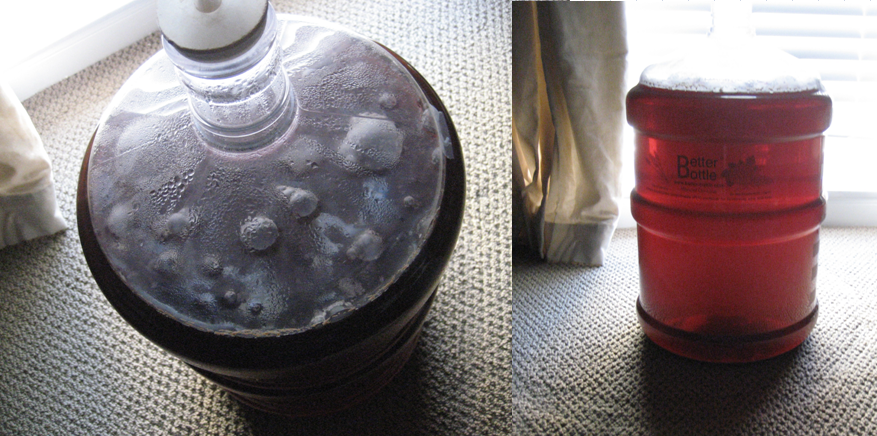
Moved to Better Bottle and pitched Rosealare. In closet so temperature will change with season. 
7/13/10 Update - This is with a couple weeks of adding the oak dowel
7/21/10 Update - that looked way to nasty so I'm done with the wood and back to a regular stopper.
11/10/10 Update - First Sample - developing nice Flander's characteristic flavors. Just barely tart and low acetic. Can't wait for the Pedio to kick in. 1.009
2/5/11 Update
Gravity - 1.010
This beer is just coming into its own. Nice aroma with some sourness and cherry. The sour in the taste is getting there. It has a touch of sharpness. Added .5 lb of maltodextrin and some Jolly Pumpkin bugs from the Black Jolly Sour   (wtf...the floater(there is a big chunk at the bottom too), I have no idea but I also don't taste a big off flavor from it)
5/4/11 Update
Gravity - 1.010
The smell is just fantastic. It was a sour cherry explosion while racking. Very little funk. But the taste is still lacking and does not live up to the smell. Just barely tart and the malt is a bit muddled. It has some good body though. Lets hope some time in the bottle will help.


 I bottled 3 gals with 110g of corn sugar - hoping around 2.5 Volumes (Tasting)
I transferred one gal into jug on top of 1 lb sour cherries (frozen from last year) (Post to come)
I kegged one gal to drink and adjust with some lactic acid and cherry juice. It was interesting to see how the lactic acid brought out the other flavors, but it was very easy to over do and give a sterile medicinal taste.
Related Posts Plugin for WordPress, Blogger...